

Purchase Order vs Subcontract

Overview
This page is intended as a general guide in order to determine whether a Purchase Order (PO) or Subcontract Agreement (SC) is the most appropriate for the relevant commitment.
Determining whether to use a Purchase Order or Subcontract Agreement depends on the complexity and risk of the goods or services involved, with POs generally suited for minor, low-risk commitments and SCs required for more complex or high-risk tasks.
The below includes some further explanations and example scenarios; however, this is not intended as an exhaustive list and professional judgement is required. At a high level, the default stance is that a subcontract agreement is required, especially if there is some form of complexity to the arrangement.
IMPORTANT NOTE: If you are engaging the services of a consultant, e.g., a fire engineer or architect, a “short form agreement for consultant engagement” document is required instead of the above options.
If any commitment requires any of the below to be contemplated, a purchase order is not appropriate, and the default document will be a subcontract agreement:
- retentions;
- bonds (performance bonds or bonds in lieu of retentions);
- Multiple stages of works
- Architectural or design services/responsibilities (must be a consultancy agreement)
- As-built documentation
Flowchart
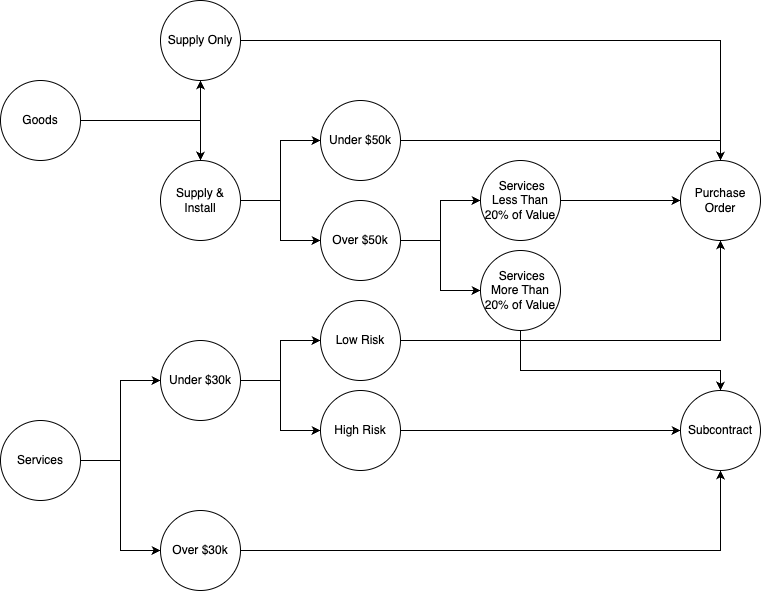
Flowchart Further Explanations
Examples of “low risk” services where a Purchase Order is likely to be appropriate:
- Blinds/glazing installation
- Small painting jobs
- Furniture orders
- Rubbish removal
- Minor services/installs (e.g. installation of 2-3 power points)
Examples of “high risk” tasks that require a subcontract (at any $ level)
- Demolition
- Carpentry
- Major services/installs (e.g. small office fit-out and above)